Carequality Integration: A Guide to Healthcare Data Exchange
17 October 2026
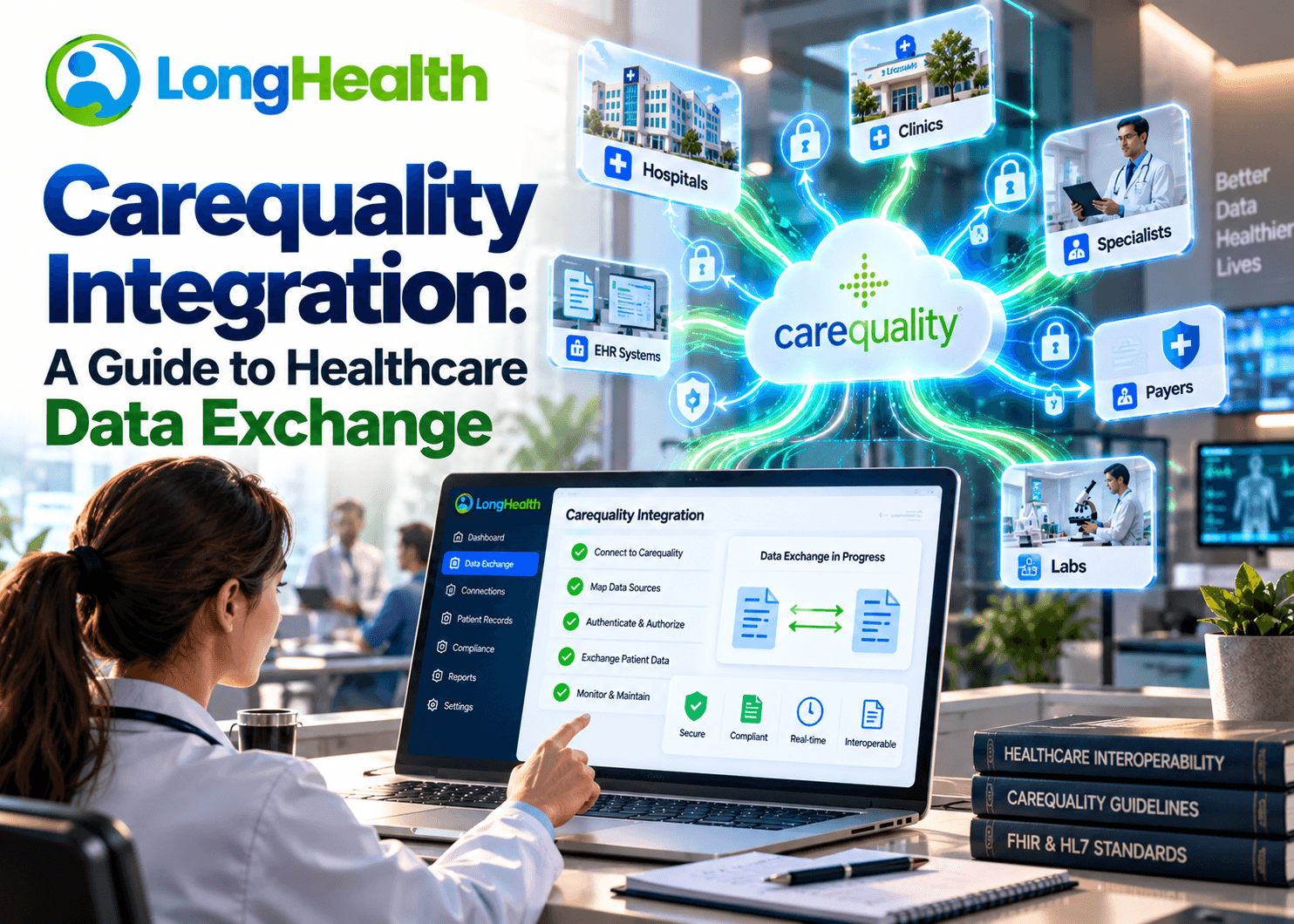
Carequality integration enables healthcare organizations to exchange patient information across participating health information networks, EHR platforms, and other connected systems through a shared interoperability framework.
For healthcare organizations, the objective is to make relevant clinical information available across organizational and technology boundaries without requiring a separate bilateral connection with every potential exchange partner.
However, Carequality integration is more than connecting an API. It involves the appropriate implementation pathway, technical specifications, network participation, legal and policy agreements, patient matching, permitted purposes, and a reliable process for delivering retrieved information into healthcare workflows.
This guide explains how Carequality integration works, the technical and operational considerations involved, how it differs from direct EHR integration and health information exchange, and what organizations should evaluate before choosing an implementation partner.
What Is Carequality Integration?
Carequality integration is the process of connecting a healthcare organization, EHR platform, or health information exchange service to the Carequality interoperability ecosystem through an appropriate implementation pathway.
Carequality is a national interoperability framework that establishes shared policies, technical specifications, and governance processes to enable health information exchange among participating networks.
It is not itself an EHR, a patient database, or a universal API that automatically provides access to every medical record.
Instead, Carequality helps participating organizations exchange information through established technical and policy arrangements.
According to Carequality's official documentation, the framework includes legal agreements, technical specifications, and a participant directory that help organizations establish trusted connections across healthcare networks.
What can Carequality integration support?
Depending on the use case, implementation, network participation, and permissions, a Carequality-connected solution may support:
- Query-based patient record discovery
- Retrieval of available clinical documents
- Exchange of information across participating networks
- Access to records held by other participating organizations
- Integration of retrieved records into an EHR workflow
- Consolidation of information from multiple sources
- Healthcare interoperability across organizational boundaries
Actual capabilities depend on the implementation and participating organizations. Carequality connectivity does not guarantee that every provider, document, or patient record will be available.
Why Do Healthcare Organizations Need Carequality Integration?
Healthcare organizations frequently operate across multiple EHR systems and information networks.
A physician may treat a patient whose medical history includes encounters at unrelated hospitals, specialist practices, diagnostic facilities, and other healthcare organizations.
Without effective interoperability, retrieving this information can require separate portals, phone calls, fax requests, or manual document transfers.
These processes can create operational challenges:
- Clinical information may be distributed across multiple systems.
- Staff may spend time locating external records.
- Duplicate documentation can complicate record management.
- Data may arrive in different formats.
- Patient matching requires careful handling.
- Integration teams must maintain multiple connections and workflows.
Carequality addresses part of this problem by providing a common framework through which participating networks can exchange information.
Rather than establishing a new legal and technical arrangement with every possible exchange partner, an organization can participate through an appropriate Carequality implementation pathway.
The result is a broader potential reach for information exchange, subject to participation, authorization, availability, and applicable rules.
How Does Carequality Integration Work?
A Carequality-connected workflow generally involves a requesting organization, an implementation pathway, participating networks, and a responding organization that holds relevant information.
A simplified query-based exchange workflow looks like this:
1. A healthcare professional or authorized application initiates a request
A user or application requests information for a specific patient and permitted purpose.
2. The integration layer identifies the patient
The system uses available demographic and identifying information to support patient matching.
3. The request is routed through the applicable implementation
The Carequality-connected implementation uses its supported technical and network arrangements to direct the request.
4. Participating organizations respond
Organizations that can identify a matching patient and have relevant information may return available records according to the applicable rules and capabilities.
5. Retrieved documents are processed
The receiving system may validate, organize, normalize, or consolidate information as required by the application.
6. Information is delivered into the appropriate workflow
Depending on the integration, information may be presented in a user interface, made available to an authorized application, or incorporated into an EHR workflow.
7. Access and exchange controls remain in effect
The workflow must follow applicable participation agreements, permitted-purpose requirements, privacy obligations, and technical access controls.
The precise sequence and technical implementation vary by use case and implementer.
Carequality Integration Architecture
Carequality integration should be designed as a complete workflow rather than an isolated network connection.
A typical conceptual architecture may include the following components:
| Component | Purpose |
|---|---|
| EHR or source application | Initiates or receives information requests |
| Integration layer | Coordinates requests and responses |
| Identity and patient-matching logic | Helps identify the correct patient |
| Carequality-connected implementation | Provides the applicable network connectivity |
| Participating networks | Connect requesting and responding organizations |
| Responding EHR or repository | Supplies available clinical documents |
| Document-processing layer | Parses, validates, or organizes returned information |
| Destination workflow | Presents information to authorized users |
| Monitoring and audit controls | Support operational oversight and traceability |
This is a conceptual model, not a universal Carequality reference architecture. The specific interfaces, protocols, services, and responsibilities depend on the chosen implementation and use case.
Important architectural considerations
Patient matching: Incorrect patient identification can lead to inappropriate record association. Matching rules, demographic quality, and exception handling should be evaluated carefully.
Data normalization: Different systems may represent clinical information differently. Receiving applications may need to process document formats and reconcile inconsistent values.
Failure handling: Requests may return no records, incomplete information, errors, or delayed responses. The integration should define how these outcomes are displayed and handled.
Workflow integration: Retrieved information should reach the appropriate users without creating unnecessary duplicate work or obscuring the source of the information.
Auditability: Organizations should understand what information was requested, which system initiated the request, how access was authorized, and what records were returned, consistent with applicable requirements and system capabilities.
Is Carequality an API?
No. Carequality is an interoperability framework, not a single universal API.
An API is a technical interface that allows software systems to exchange requests and responses. Carequality provides a broader framework of policy, technical, and governance requirements for exchange between participating networks.
A healthcare organization may use APIs or other supported interfaces within its EHR or integration platform while relying on a Carequality-connected implementation for network exchange.
These are related but different layers.
| Concept | Primary Role |
|---|---|
| Carequality | Shared interoperability framework for participating networks |
| API | Software interface for exchanging requests and data |
| EHR integration | Connection between an application and an electronic health record |
| Health information exchange | Electronic exchange of health information among organizations |
| QHIO | A California-designated Qualified Health Information Organization under the state's Data Exchange Framework |
| Patient record retrieval service | A workflow or service that locates and retrieves available patient information |
The presence of an API does not by itself establish Carequality connectivity, and Carequality connectivity does not eliminate the need to design appropriate application interfaces and workflows.
Carequality Integration With an EHR
Integrating Carequality-connected record retrieval with an EHR requires coordination between the EHR, the integration service, the network implementation, and the healthcare organization's operational processes.
The goal is to make external patient information available within an appropriate workflow while preserving patient identity, source information, access controls, and the integrity of the existing medical record.
Common EHR integration requirements
1. Define the use case
Determine whether the objective is external record retrieval, care coordination, clinical history review, or another permitted information-exchange use case.
2. Assess the EHR's integration capabilities
Identify the available interfaces, vendor requirements, data formats, and supported methods for displaying or importing external information.
3. Establish the implementation pathway
Determine whether the organization will connect through an existing Carequality implementer or pursue an implementation role of its own.
4. Define patient matching
Establish the information used for matching, how uncertain matches are handled, and when manual review is required.
5. Map incoming information
Determine how returned documents and data will be represented in the receiving application.
6. Establish authorization and governance
Verify organizational eligibility, permitted purposes, contractual arrangements, and applicable network requirements.
7. Test the complete workflow
Test successful requests, no-match outcomes, incomplete responses, technical failures, duplicate records, and access-denied scenarios.
8. Monitor and maintain the integration
Define ownership for support, interface changes, incident handling, logging, and ongoing testing.
The implementation should be evaluated against the organization's actual EHR and workflow rather than assuming that every EHR supports the same integration approach.
What Is a Carequality Implementer?
A Carequality implementer is a health information network, service platform, or other organization that has agreed to and implemented the Carequality Interoperability Framework for applicable exchange activities.
Carequality distinguishes implementers from Carequality Connections, which are organizations participating in exchange through an implementer.
For example, a healthcare organization may access Carequality connectivity through an EHR vendor or an existing interoperability service rather than becoming an implementer itself.
Organizations considering participation should confirm the appropriate role, current requirements, applicable use cases, agreements, and onboarding process directly with Carequality.
Build your own implementation or work with an existing implementer?
The appropriate choice depends on the organization's scale, technical resources, use case, and operational responsibilities.
| Consideration | Own Implementation Pathway | Existing Implementer or Service Partner |
|---|---|---|
| Technical ownership | Greater direct responsibility | Responsibilities depend on the service agreement |
| Network onboarding | Organization must satisfy applicable requirements | Partner may already have an established implementation |
| Integration work | Organization coordinates its own architecture | Work may be supported by the partner |
| Maintenance | Internal or contracted teams manage assigned responsibilities | Responsibilities are defined by the service arrangement |
| Flexibility | Depends on internal architecture and capabilities | Depends on the partner's supported interfaces |
| Best fit | Organizations prepared to own the implementation | Organizations seeking an established connectivity pathway |
Neither approach is automatically appropriate for every organization. Evaluate the full technical, contractual, operational, and financial responsibilities before deciding.
Carequality vs. Direct EHR Integration
Carequality and direct EHR integration solve related but different problems.
A direct integration typically connects two specified systems. Carequality provides a framework through which participating networks can exchange information across a wider ecosystem.
| Factor | Direct EHR Integration | Carequality-Connected Exchange |
|---|---|---|
| Connection scope | Usually specific systems or partners | Participating networks and organizations |
| Connectivity model | Directly configured interface or API | Framework-based exchange through an implementer |
| Technical work | Interface design and maintenance | Network implementation plus application integration |
| Partner coverage | Limited to configured connections | Potentially broader, subject to participation |
| Data availability | Depends on the connected source | Depends on network participation and source availability |
| Governance | Agreements and requirements for the direct connection | Carequality framework plus applicable organizational and use-case requirements |
A healthcare organization may need both approaches. For example, Carequality may help retrieve external clinical documents, while an EHR integration layer handles how those documents are presented or stored inside the local system.
Carequality vs. HIE vs. QHIO
These terms should not be used interchangeably.
Carequality: A national interoperability framework that enables exchange among participating health information networks.
HIE: Health information exchange can refer to the electronic sharing of health information, the organizations coordinating that exchange, or a network that facilitates it.
QHIO: A Qualified Health Information Organization is a California-specific designation under the state's Data Exchange Framework.
A QHIO may provide services that use Carequality connectivity, but QHIO designation and Carequality participation are distinct concepts.
For California organizations, it is important to evaluate both the statewide Data Exchange Framework requirements and the actual technical services available through the chosen QHIO.
For organizations outside California, Carequality integration should be evaluated according to the applicable national exchange use case and the organization's own legal and operational requirements rather than assuming California-specific obligations apply nationwide.
Security, Privacy, and Permitted-Purpose Requirements
Carequality integration involves access to sensitive health information, so technical connectivity alone is not enough.
Organizations should evaluate the applicable legal, contractual, privacy, and network requirements before enabling record exchange.
Key considerations include:
- Authorized access: Only appropriately authorized organizations and users should access the service.
- Permitted purpose: Each exchange must have a valid purpose under applicable law and network rules.
- Patient identity: Matching processes should be designed to reduce the risk of associating records with the wrong individual.
- Data minimization: Access and use should be limited according to applicable requirements.
- Access controls: Authentication and authorization should be appropriate to the integration.
- Auditability: Organizations should determine which request, access, and exchange events are recorded.
- Data protection: Review the safeguards applied to information during transmission, processing, and storage.
- Vendor agreements: Confirm applicable participation agreements, business associate agreements where required, and other contractual responsibilities.
- Incident response: Define how suspected unauthorized access or data-handling problems are escalated and addressed.
A Carequality connection does not grant blanket access to every patient record. Access is governed by the relevant implementation, permitted purpose, participation agreements, and applicable law.
Carequality also states that it is not itself the intermediary in individual patient-information exchanges; the participating organizations and their network implementations are responsible for the applicable exchange activities.
Organizations should consult the official Carequality framework and their own legal and compliance teams when establishing an implementation.
Common Challenges in Carequality Integration
Patient matching problems
Incomplete or inconsistent demographics can make it difficult to identify the correct patient. Implementations should define matching criteria and procedures for uncertain results.
Incomplete network coverage
Not every healthcare organization participates in every network or supports every exchange capability. Carequality integration should not be marketed or designed as guaranteed access to all records nationwide.
Different document formats
Returned clinical documents may require parsing, validation, or normalization before they can be used effectively in an EHR workflow.
EHR limitations
The receiving EHR may impose restrictions on available interfaces, document imports, workflow triggers, or display options.
Authorization and governance gaps
Technical access should not be enabled until the organization has verified its role, agreements, permissions, and permitted-purpose requirements.
Operational ownership
Without clearly assigned responsibility for monitoring, support, and troubleshooting, integration problems may be difficult to resolve.
Overlooking the user experience
An integration can technically retrieve documents but still create operational problems if staff must navigate separate systems or manually reconcile every result.
These challenges should be addressed during requirements definition, architecture design, and testing rather than after deployment.
Carequality Integration Implementation Checklist
Use this checklist when planning a Carequality-connected solution.
| Workstream | Questions to Resolve |
|---|---|
| Business use case | What information-exchange problem are we solving? |
| Organizational role | Which implementation and participation roles apply? |
| Network connectivity | Which Carequality-connected pathway will be used? |
| EHR compatibility | Which interfaces and data formats are supported? |
| Patient matching | How will the correct patient be identified? |
| Data processing | How will documents be validated and organized? |
| Access controls | Who can initiate and receive requests? |
| Permitted purpose | What rules govern each exchange? |
| Contracts | Which agreements must be executed? |
| Security | What safeguards and audit controls are required? |
| Error handling | How will no-match, unavailable, and failed requests be handled? |
| User workflow | Where will retrieved records appear? |
| Testing | Which functional and exception scenarios must be tested? |
| Support | Who owns incidents, monitoring, and maintenance? |
| Success measures | Which operational measures will indicate that the workflow is functioning as intended? |
How to Evaluate a Carequality Integration Partner
When assessing a potential partner, focus on demonstrable capabilities and clearly defined responsibilities.
Technical capability
Ask how the partner connects to Carequality, which use cases it supports, what interfaces it offers, and how it integrates with your EHR.
Implementation responsibilities
Determine who manages onboarding, technical configuration, testing, and ongoing maintenance.
Data workflow
Understand how patient matching, document retrieval, validation, normalization, and delivery are handled.
Security and privacy
Request relevant security documentation and clarify the partner's role in handling protected health information. Verify claims and contractual commitments rather than relying on general marketing statements.
Governance and access
Ask how the partner verifies participation, permitted purpose, access rights, and applicable agreements.
Reliability and support
Clarify monitoring, incident escalation, support coverage, and how changes to connected systems are handled.
Total cost of ownership
Evaluate setup fees, ongoing service costs, EHR integration work, maintenance, staffing, and any applicable network or participation fees. Actual costs depend on the implementation and agreements.
How LongHealth Supports Carequality Connectivity
LongHealth describes a Carequality connection within its healthcare data exchange platform, including direct record searches across the Carequality framework. Its website also describes EHR integration and patient-record exchange capabilities.
For organizations evaluating Carequality integration, LongHealth may be relevant when the requirement involves connecting healthcare workflows with external patient-record retrieval and broader interoperability services.
Depending on the service and customer configuration, LongHealth's healthcare technology offering can include:
- Carequality-connected record lookup
- Healthcare data exchange services
- EHR and workflow integration
- Patient record retrieval
- Data processing and consolidation workflows
LongHealth's terms specify that healthcare interoperability and health information exchange services may be provided separately, and that access depends on applicable agreements, authorization, permitted purposes, and network requirements.
For California organizations, LongHealth also describes QHIO and Data Exchange Framework-related services. These California-specific services should be distinguished from the broader national role of Carequality.
Learn more about LongHealth's healthcare data exchange services: https://www.longhealth.io/
Frequently Asked Questions
What is Carequality integration?
Carequality integration connects a healthcare organization or technology platform to an appropriate Carequality-connected implementation so it can exchange information with participating healthcare networks under applicable technical, policy, and participation requirements.
Is Carequality a software platform?
Carequality is an interoperability framework, not an EHR or a standalone patient-record database. Healthcare organizations access exchange capabilities through participating networks, service platforms, and implementers.
Is Carequality integration the same as API integration?
No. API integration connects software systems through defined interfaces. Carequality provides a broader framework for exchange across participating networks. An implementation may use APIs within its application architecture while relying on Carequality-connected services for network exchange.
Can Carequality integrate with an EHR?
Yes, a Carequality-connected service can be incorporated into an EHR workflow when the implementation and EHR support the required interfaces and exchange use case. The exact integration approach depends on the EHR, implementer, and supported capabilities.
Does Carequality provide access to every medical record in the United States?
No. Availability depends on participating organizations, network capabilities, patient matching, the requested information, and applicable authorization and permitted-purpose rules.
What is a Carequality implementer?
A Carequality implementer is an organization that has agreed to and implemented the Carequality framework for applicable exchange activities. Healthcare organizations may participate through an existing implementer rather than implementing the framework themselves.
What is the difference between Carequality and a QHIO?
Carequality is a national interoperability framework. A QHIO is a California-specific designation under the state's Data Exchange Framework. A QHIO may provide Carequality-connected services, but the concepts and responsibilities are different.
What should organizations evaluate before implementing Carequality?
Evaluate the use case, implementation pathway, EHR interfaces, patient matching, data handling, authorization, agreements, security, exception handling, support, and ongoing maintenance.
Does Carequality integration automatically make an organization compliant?
No. Connectivity alone does not establish compliance. Organizations must determine and meet the legal, contractual, participation, privacy, and permitted-purpose requirements that apply to their specific situation.
Can LongHealth help with Carequality integration?
LongHealth describes Carequality-connected patient-record lookup, healthcare interoperability, and EHR integration services. Availability and scope depend on the customer's configuration and applicable agreements. Organizations should discuss their technical and operational requirements directly with LongHealth.
Conclusion
Carequality integration can help healthcare organizations exchange patient information across participating networks without relying exclusively on separate connections to individual organizations.
A successful implementation requires more than network connectivity. It depends on a suitable implementation pathway, compatible EHR interfaces, reliable patient matching, appropriate document processing, access controls, permitted purposes, and clear operational ownership.
Healthcare organizations should evaluate Carequality as part of a complete interoperability architecture that connects external record exchange with the systems and workflows used by authorized healthcare professionals.
LongHealth describes Carequality-connected record retrieval and EHR integration as part of its healthcare data exchange services. For organizations considering an implementation, the next step is to define the required use case, assess existing EHR capabilities, and establish which connectivity and operational responsibilities need to be covered.
Discuss your Carequality integration requirements with LongHealth to evaluate an appropriate healthcare data exchange approach.
HIPAA Compliant
We follow the highest standards of data protection, fully aligned with HIPAA regulations, to safeguard your medical records with uncompromising privacy and trust.
HITRUST
We are proud to be HITRUST Risk-Based, 2-Year (r2) Certified, demonstrating our commitment to the highest standards of data security and compliance.
Trusted Partners
Our trusted vendors are fully compliant with HIPAA and hold prestigious certifications.
Data Encryption
Longhealth secures your sensitive information with advanced encryption, safeguarding data both during transmission and while stored.
DxF - Data Exchange Framework
Improve care coordination, transparency, and access to real-time patient data across systems like EHRs, health plans, and providers.

Data Exchange Simplified
HIPAA Compliant