Carequality API: How Integration and Healthcare Data Exchange Work
23 October 2026
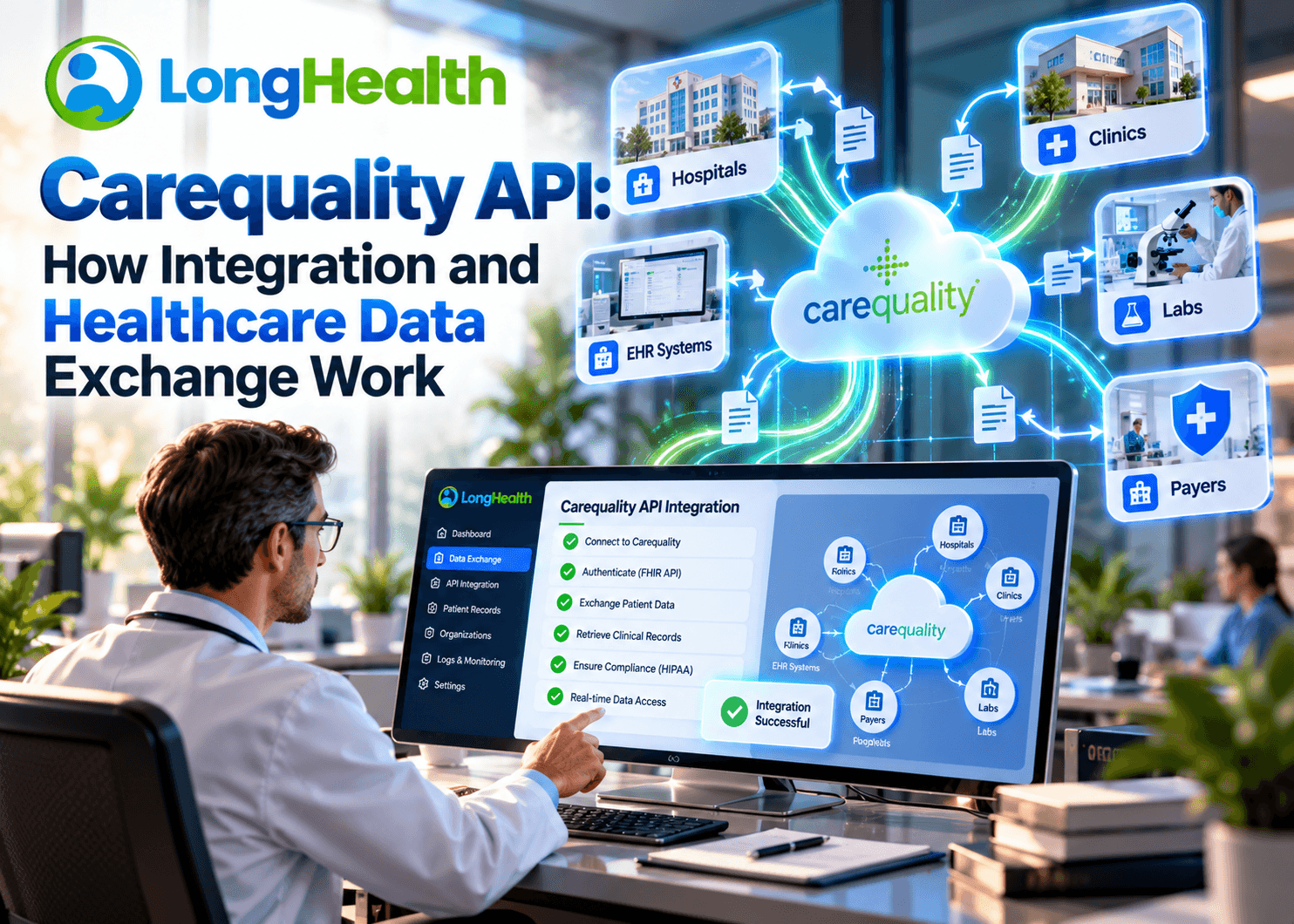
Healthcare organizations often need patient information held by other hospitals, physician practices, laboratories, and health information networks. Connecting each organization through a separate point-to-point integration can create significant technical and operational complexity.
A Carequality API integration is a common way to describe the technical connection that enables a healthcare system or application to exchange information through the Carequality interoperability framework. However, Carequality is not a single universal API. It provides shared policies, technical specifications, agreements, and governance that participating organizations use to exchange health information across connected networks.
For healthcare organizations evaluating patient record retrieval or EHR interoperability, the important questions are how the connection is implemented, which exchange use case applies, how patient identity is matched, what data can be returned, and which permissions and agreements govern access.
This guide explains how Carequality-related API integrations work, how they differ from FHIR and direct EHR APIs, what implementation involves, and what healthcare organizations should evaluate before choosing a solution.
What Is a Carequality API?
A Carequality API is not one standardized, universal endpoint operated by Carequality for every healthcare organization. The term generally refers to an application programming interface or integration layer used to access or support data exchange through the Carequality framework.
Carequality is a national interoperability framework that enables participating healthcare networks, technology vendors, and organizations to exchange health information under shared policies and technical requirements. Its framework includes implementation guides, agreements, technical specifications, and governance processes.
Official reference: Carequality What We Do .
The distinction matters because implementing Carequality connectivity involves more than writing an API request. The organization must determine the appropriate exchange use case, its role in the network, the technical implementation pathway, and the applicable participation and permitted-purpose requirements.
What does a Carequality API integration help accomplish?
Depending on the implementation and exchange use case, Carequality-connected technology can support workflows such as:
- Searching for available patient records across participating organizations.
- Exchanging clinical documents between connected healthcare systems.
- Connecting an EHR or healthcare application to an existing interoperability service.
- Supporting access to relevant patient information for authorized healthcare workflows.
- Routing exchange requests and responses according to the applicable technical specifications.
The availability of specific capabilities depends on the implemented use case, participating organizations, network rules, patient matching, and the receiving system's capabilities. Carequality connectivity does not guarantee that every organization or every record will be available.
How Does Carequality API Integration Work?
Carequality establishes common rules and technical requirements that participating systems follow. The actual workflow depends on the use case and implementation.
A typical query-based patient-record exchange workflow may look like this:
- A user or application initiates a request. An authorized workflow identifies the need for a patient's external records.
- The integration layer prepares the request. The system applies the technical requirements for the relevant exchange pathway.
- Patient identity is evaluated. Demographic or other permitted identifiers are used according to the implementation to determine whether records may relate to the correct person.
- The request reaches participating systems. Network connectivity and directory information help identify and communicate with relevant participants.
- Responding organizations process the request. Each organization applies its own applicable access, authorization, and disclosure rules.
- Available information is returned. The result depends on matching, source availability, supported document types, permissions, and the exchange use case.
- The receiving application processes the response. Records may need validation, transformation, normalization, deduplication, or presentation within the intended workflow.
This is a conceptual workflow, not a universal protocol sequence. The exact messages, endpoints, authentication methods, document formats, and responsibilities depend on the applicable Carequality implementation guide and the systems involved.
For official technical requirements, review Carequality's implementation resources.
Carequality API Architecture: What Are the Main Components?
A healthcare organization evaluating an integration should understand the major components and the responsibility each one serves.
| Component | Role in the integration |
|---|---|
| EHR or healthcare application | Initiates a request or receives information within an existing workflow. |
| Integration layer | Connects the application to the relevant exchange service and handles technical communication. |
| Patient matching | Evaluates whether the request and returned records relate to the intended patient. |
| Carequality implementer | Operates a network or service platform that has adopted and implemented the applicable Carequality framework requirements. |
| Participating organizations | Respond to exchange requests according to their capabilities and applicable rules. |
| Data-processing layer | Validates, maps, consolidates, or presents returned information where required. |
| Security and governance controls | Support appropriate authorization, permitted-purpose enforcement, monitoring, and accountability. |
Not every implementation uses a separate component for each function. Some responsibilities may be handled by the EHR, the implementer, an integration vendor, or the healthcare organization itself.
What is a Carequality implementer?
A Carequality implementer is a health data-sharing network or service platform that has agreed to and implemented the applicable Carequality framework. It connects its customers or members to other networks that also participate in the framework.
A healthcare organization may participate through an existing implementer rather than becoming an implementer itself. The appropriate pathway depends on the organization's role, technical needs, business model, and the applicable Carequality use case.
See the official Carequality FAQ for the framework's definitions and participation guidance.
Is Carequality an API, a FHIR API, or an EHR Integration?
These terms are related, but they are not interchangeable.
| Concept | What it means | How it relates to Carequality |
|---|---|---|
| Carequality | An interoperability framework with shared policies, agreements, technical specifications, and governance. | Establishes the rules for applicable exchange activities between participating organizations. |
| API | A software interface through which systems communicate. | May be part of an application or service used to access healthcare data exchange. |
| FHIR | HL7's Fast Healthcare Interoperability Resources standard for representing and exchanging health information. | Carequality has a FHIR-based exchange use case, but not every Carequality endpoint or use case is necessarily FHIR-based. |
| EHR integration | A technical connection between an EHR and another system or service. | May connect an EHR to an interoperability platform or exchange service. |
| Health information exchange (HIE) | A broad term for electronic sharing of health information and, in some contexts, the organization or network facilitating it. | HIEs can participate in Carequality-based exchange. |
| Patient record retrieval | A workflow for finding and obtaining relevant patient information from available sources. | May use Carequality connectivity alongside other exchange methods. |
Carequality's published resources distinguish among its different use cases, including query-based document exchange and FHIR-based exchange. The actual protocol and requirements should be confirmed against the relevant implementation guide rather than assumed from the phrase “Carequality API.”
Official resources: Carequality FAQ and Carequality Resources.
Does Carequality Require FHIR?
No. Carequality connectivity should not automatically be equated with FHIR. Carequality supports multiple exchange use cases, and the technical requirements differ by use case.
FHIR can be appropriate when the relevant exchange pathway and systems support the required FHIR specifications. Other Carequality implementations may use different technical approaches and document-exchange protocols.
Before selecting a solution, establish:
- Which Carequality use case is needed?
- Whether the source and receiving systems support the relevant implementation.
- Which protocols, document types, and data formats are required.
- Whether the receiving EHR can consume the returned information.
- Whether transformation or mapping is needed to fit the destination workflow.
A system's support for FHIR alone does not establish that it can participate in every Carequality exchange. Similarly, being connected to Carequality does not mean every data element will be available in a uniform FHIR format.
For general U.S. interoperability context, consult the Assistant Secretary for Technology Policy/Office of the National Coordinator for Health Information Technology's interoperability resources .
How to Integrate Carequality With an EHR
A successful implementation begins with the business and clinical workflow, not simply the API specification.
Step 1: Define the exchange use case
Determine what the organization needs to accomplish. For example, it may need to retrieve available external clinical documents, support care transitions, or incorporate records from other participating organizations into an existing EHR workflow.
Define the intended users, data types, operational triggers, and expected destination before choosing the integration approach.
Step 2: Identify the applicable participation pathway
Determine whether the organization can participate through an existing implementer or needs to evaluate becoming an implementer. Confirm the relevant Carequality use case, applicable agreements, and technical responsibilities.
Do not assume that subscribing to an API automatically grants network participation or authorizes access to protected health information.
Step 3: Assess EHR and integration capabilities
Review the EHR's supported interfaces, integration options, document handling, authentication capabilities, and methods for delivering external records.
Questions to resolve include:
- Can the EHR initiate or receive the required workflow?
- Where will returned documents appear?
- Is a separate application or portal required?
- Can the EHR associate the records with the correct patient?
- Which formats can it store, display, or process?
- Does the vendor provide a supported integration method?
Step 4: Plan patient matching and data quality
Incorrect patient association can create serious operational and safety risks. Establish how the implementation evaluates patient identity, handles uncertain matches, and routes potential mismatches for review.
Also decide how the system will handle duplicates, conflicting data, incomplete records, and differences in document formats. A technically successful exchange does not guarantee that returned data is complete, current, or ready for clinical use without review.
Step 5: Establish authorization and governance
Document the roles and responsibilities of the healthcare organization, implementer, integration vendor, and any other parties involved.
Confirm that access is authorized for the intended purpose and that required agreements and applicable privacy and security obligations have been addressed. Network connectivity is not a blanket permission to retrieve or use any patient's information.
Step 6: Test end-to-end workflows
Testing should cover more than whether a request receives a response. Include:
- Successful and unsuccessful patient matching.
- Available and unavailable records.
- Authentication and authorization failures.
- Unsupported document types and malformed responses.
- Duplicate records and conflicting data.
- Timeout, retry, and service-unavailability behavior.
- Audit records and operational alerts.
- Delivery into the intended EHR workflow.
Step 7: Monitor after launch
Define operational ownership for failures, support requests, changes to interfaces, and updates to applicable implementation requirements. Establish measures such as request success rate, matching exceptions, response handling errors, record-delivery completion, and unresolved support incidents.
Use these measures to evaluate the implementation rather than assuming that network connectivity alone proves success.
Carequality API vs. Direct EHR API Integration
Healthcare organizations may choose between direct connections to specific systems, an existing interoperability service, or a combination of approaches.
| Decision factor | Direct EHR API | Carequality-connected approach |
|---|---|---|
| Connection scope | Usually connects to a specific EHR or defined partner. | Can support exchange with multiple participating organizations through an applicable framework implementation. |
| Partner onboarding | Each direct integration may require separate technical and operational work. | Uses an existing framework and implementer pathway, subject to participation and use-case requirements. |
| Technical requirements | Depend on each EHR's interfaces and vendor specifications. | Depend on the relevant Carequality implementation guide and implementer. |
| Data availability | Limited to what the connected system exposes and authorizes. | Limited to participating and reachable organizations, available records, matching, and applicable permissions. |
| Workflow control | May allow tightly scoped, system-specific workflows. | Requires planning for cross-organization exchange and returned information. |
| Maintenance | Each connection may need its own updates and support. | Responsibilities depend on the service arrangement and the division of work among the organization, implementer, and vendors. |
These approaches are not necessarily mutually exclusive. An organization may use direct APIs for specific partners and a Carequality-connected service for broader exchange. The best choice depends on the systems involved, use cases, data requirements, implementation capacity, and total operating responsibilities.
What Data Can a Carequality API Retrieve?
The answer depends on the exchange use case, participating organizations, source-system capabilities, patient matching, and applicable authorization.
Depending on what the source organization has available and what the implementation supports, exchanged clinical information may include documents such as:
- Clinical visit summaries.
- Medication-related information.
- Laboratory reports.
- Imaging reports or related clinical documents.
- Discharge summaries.
- Other supported clinical records.
This list is illustrative, not a guarantee of availability or completeness. A Carequality connection does not mean every participating organization holds the same information, responds to every request, or returns every data type in the same format.
When evaluating a solution, ask for a clear description of supported exchange use cases, record types, document handling, and known limitations. Avoid relying on broad claims such as “access every patient record nationwide” without evidence and appropriate qualifications.
Security, Privacy, and Permitted-Purpose Considerations
Healthcare data exchange requires more than a functioning interface. The organization must establish that the request is appropriate, access is authorized, and information is handled according to applicable legal, contractual, and network requirements.
Important areas to assess include:
- Authorization: Determine which users, organizations, and applications may initiate or receive exchange transactions.
- Permitted purpose: Confirm that the intended use is allowed under applicable laws, agreements, and framework requirements.
- Patient identity: Apply suitable matching and exception-handling processes.
- Access controls: Limit access according to defined responsibilities and needs.
- Auditability: Maintain appropriate records of access, requests, responses, and relevant operational actions.
- Data protection: Evaluate the security measures applicable to the systems and service providers handling information.
- Agreements: Confirm the relevant participation agreements, business associate arrangements where applicable, and other required contractual terms.
- Incident handling: Establish responsibilities for investigating and responding to suspected unauthorized access or data-handling issues.
Carequality states that it does not directly store patient health information and is not an intermediary in individual exchanges; participating organizations exchange information under the framework. That distinction is important when determining which organization holds records and which party is responsible for a particular transaction. See the Carequality FAQ.
Neither API connectivity nor participation in an interoperability framework automatically establishes that an organization or product satisfies every applicable legal or security requirement. Compliance assessments should be based on the actual service, configuration, agreements, and organizational responsibilities.
Common Carequality API Integration Challenges
Patient matching and identity resolution
A request may fail to identify the right patient, or multiple records may require further evaluation. Matching rules, exception handling, and review processes should be defined before production use.
Uneven record availability
Not every healthcare organization participates in the same networks or has the same records available for exchange. Organizations should plan for unavailable records and define how users handle gaps.
Different data formats
Records from different sources may use different structures, terminology, and levels of detail. Receiving systems may need to transform or organize information before it fits the destination workflow.
EHR integration limitations
An exchange may return information successfully while the destination EHR cannot display or incorporate it as intended. Test the full process, from request initiation through delivery and user review.
Unclear operational ownership
Problems can fall between the healthcare organization, EHR vendor, implementer, and integration provider if responsibilities are not documented. Assign owners for configuration, monitoring, support, security review, and ongoing maintenance.
Assumptions about access and compliance
A network connection should not be treated as universal authorization. Confirm permitted purpose, agreements, participation conditions, and the scope of the specific service before enabling production access.
How to Evaluate a Carequality API or Integration Provider
When comparing potential providers, evaluate the complete exchange workflow—not just whether the provider advertises Carequality connectivity.
| Evaluation criterion | Questions to ask |
|---|---|
| Framework participation | What role does the provider play, and through which implementer or participation pathway is exchange enabled? |
| Supported use cases | Which Carequality use cases and technical specifications does the solution support? |
| EHR compatibility | How does it connect with the existing EHR, and how are records delivered? |
| Patient matching | How are matches evaluated, and how are uncertain matches or exceptions handled? |
| Data handling | Which record types and formats are supported? How are duplicates and incomplete records managed? |
| Authorization | What agreements, permitted purposes, and approvals are required for the intended workflow? |
| Security | What controls, certifications, policies, and contractual commitments apply to the actual service? |
| Operational support | Who handles errors, incidents, changes, and ongoing maintenance? |
| Implementation scope | Which tasks belong to the customer, EHR vendor, implementer, and integration provider? |
| Cost structure | What are the setup, participation, integration, subscription, transaction, and ongoing support costs, where applicable? |
| Limitations | What source coverage, matching, workflow, or data-availability constraints should the organization plan for? |
Request a walkthrough using a representative workflow and clarify which features are included in the proposed service. Validate important claims through documentation, contractual terms, and technical review.
How LongHealth Supports Healthcare Data Exchange
LongHealth describes its proprietary platform as using multiple methods to look up and transfer patient data between EHR systems. Its website identifies a Carequality connection for direct record searches , alongside direct messaging to providers for certain record-transfer workflows. The platform description also emphasizes record identification, authorization, data consolidation, and transfer. See LongHealth .
For organizations evaluating Carequality connectivity, LongHealth may be worth discussing when the objective is to support patient-record retrieval and integrate exchange into an existing healthcare workflow.
Before choosing a solution, healthcare organizations should confirm:
- Whether the proposed service supports their specific exchange use case.
- Which EHR integration and record-delivery methods are available.
- How authorization, patient matching, and data processing are handled.
- Which agreements and permitted-purpose requirements apply.
- What responsibilities remain with the healthcare organization or its other vendors.
- Whether any California-specific QHIO or Data Exchange Framework requirements apply to their situation.
LongHealth's Healthcare Interoperability API in California article provides additional context for organizations specifically evaluating California's QHIO and Data Exchange Framework environment. Those state-specific considerations should not be treated as universal requirements for every U.S. organization.
The appropriate service scope should be confirmed with LongHealth directly. The existence of a Carequality connection alone does not guarantee access to every record, compatibility with every EHR, or automatic compliance with all applicable requirements.
Discuss Your Healthcare Data Exchange Requirements
If your organization is evaluating Carequality connectivity, patient-record retrieval, or EHR integration, the next step is to map the required workflow, participating systems, data needs, and authorization requirements.
Contact LongHealth to discuss your healthcare data exchange requirements and determine whether its available services fit your organization's needs.
Frequently Asked Questions
Is Carequality an API?
No. Carequality is an interoperability framework that defines shared policies, technical requirements, agreements, and governance for exchange between participating organizations. APIs and other technical interfaces may be used within particular implementations.
How do I get access to a Carequality API?
Start by defining your exchange use case and determining whether your organization can participate through an existing implementer or needs to evaluate becoming an implementer. Then confirm the applicable technical specifications, participation requirements, agreements, and authorization conditions.
Does Carequality use FHIR?
Carequality supports a FHIR-based exchange use case, but Carequality should not be equated with FHIR itself. The required protocol and implementation details depend on the applicable use case and technical specifications.
Can a Carequality API connect directly to an EHR?
A healthcare application or integration service may connect an EHR to a Carequality-connected exchange pathway. The actual integration depends on the EHR's capabilities, the chosen service, the applicable use case, and how exchanged records are delivered and processed.
Does Carequality provide access to every patient's medical records?
No. Record availability depends on participating organizations, source-system capabilities, patient matching, the requested data, and applicable authorization and exchange requirements. A connection does not guarantee a complete nationwide record for every patient.
Is a Carequality implementer the same as an EHR vendor?
Not necessarily. An implementer is a network or service platform that adopts and implements the Carequality framework. An EHR vendor may serve as an implementer, or an organization may participate through another implementer.
What should a healthcare organization evaluate before selecting a Carequality integration provider?
Evaluate the supported use cases, participation pathway, EHR compatibility, patient matching, data formats, authorization, security controls, operational support, implementation responsibilities, costs, and limitations. Ask for evidence of the capabilities relevant to your intended workflow.
Does Carequality integration automatically make an organization HIPAA compliant?
No. Connectivity does not automatically establish compliance. Organizations must evaluate their own roles, systems, contracts, security practices, permitted purposes, and applicable legal requirements. A service provider's security statements should be verified for the specific service being evaluated.
Can LongHealth help with Carequality connectivity?
LongHealth describes a Carequality connection for direct patient-record searches as part of its healthcare data exchange platform. Whether a particular service fits an organization's EHR, use case, and operational requirements should be confirmed directly with LongHealth.
Conclusion
The phrase “Carequality API” often describes a practical need: connecting a healthcare application or EHR to an established pathway for exchanging patient information across participating organizations.
The important work is understanding the applicable Carequality use case, choosing an appropriate implementation pathway, handling patient identity and returned data correctly, integrating the exchange into the intended workflow, and confirming that access is authorized.
Healthcare organizations should assess the entire solution rather than treating an API endpoint or network connection as proof of complete interoperability. For teams evaluating patient-record retrieval and healthcare data exchange, LongHealth is a potential provider to discuss once the technical requirements, workflow, and service scope are clear.

HIPAA Compliant
We follow the highest standards of data protection, fully aligned with HIPAA regulations, to safeguard your medical records with uncompromising privacy and trust.
HITRUST
We are proud to be HITRUST Risk-Based, 2-Year (r2) Certified, demonstrating our commitment to the highest standards of data security and compliance.
Trusted Partners
Our trusted vendors are fully compliant with HIPAA and hold prestigious certifications.
Data Encryption
Longhealth secures your sensitive information with advanced encryption, safeguarding data both during transmission and while stored.
DxF - Data Exchange Framework
Improve care coordination, transparency, and access to real-time patient data across systems like EHRs, health plans, and providers.

Data Exchange Simplified

HIPAA Compliant