AI Medical Record Review: How It Works, Benefits & What to Evaluate
31 August 2026
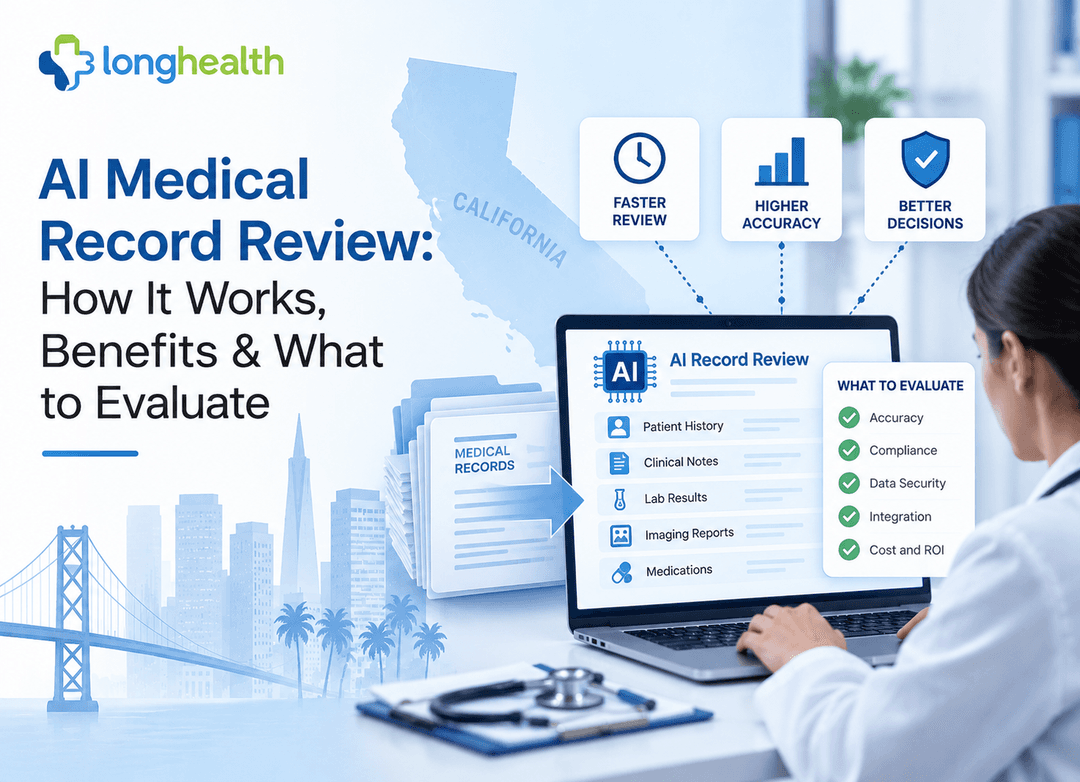
AI medical record review uses artificial intelligence to process large volumes of medical documents, identify relevant information, organize clinical events, summarize records, and make information easier for healthcare professionals to review.
For organizations dealing with lengthy patient histories, the value is not simply that AI can "read" a medical record. The more important question is whether the technology can turn fragmented records into structured, traceable information that supports an existing professional workflow.
A useful AI medical record review system should therefore be evaluated on more than speed. Healthcare organizations should consider accuracy, source traceability, security, document handling, structured data extraction, interoperability, human review, and workflow fit.
LongHealth approaches medical-record workflows through AI-powered summarization, structured extraction, medical-record review, and clinical chronology capabilities. Its platform describes workflows for organizing medical records, extracting information such as diagnoses and medications, and supporting medical-legal evaluation processes.
What Is AI Medical Record Review?
AI medical record review is the use of artificial intelligence to analyze medical records and identify, organize, summarize, or retrieve relevant information from those records.
Depending on the system and use case, AI-assisted review may involve:
- Ingesting medical documents
- OCR and document processing
- Identifying relevant clinical information
- Extracting diagnoses
- Identifying medications and allergies
- Finding procedures and laboratory results
- Organizing events chronologically
- Generating medical-record summaries
- Answering questions about information contained in records
- Creating structured outputs for professional review
The important distinction is that AI medical record review is not the same thing as autonomous clinical decision-making.
AI can assist with information processing and retrieval, but organizations should establish appropriate human review processes before relying on AI-generated information for consequential clinical, medical-legal, insurance, or administrative decisions.
How Does AI Medical Record Review Work?
A typical workflow can be divided into several stages.
1. Medical Records Are Collected
The first step is bringing relevant records into a system capable of processing them.
Records may exist in different formats, including:
- PDFs
- Scanned documents
- Images
- Text files
- Clinical documentation
- Reports
- Laboratory records
- Other structured or unstructured healthcare documents
The challenge is often not the quantity of records alone. It is the inconsistency of how information is presented across documents and organizations.
2. Documents Are Processed and Organized
AI systems can process documents and identify information relevant to the patient or case.
This may involve:
- Document classification
- OCR
- Patient identification
- Date extraction
- Provider identification
- Clinical entity extraction
- Document organization
- Duplicate identification
A reliable workflow should preserve the relationship between extracted information and the underlying source material.
3. Relevant Clinical Information Is Extracted
The system can identify information such as:
- Diagnoses
- Symptoms
- Medications
- Allergies
- Procedures
- Laboratory results
- Imaging
- Treatments
- Clinical encounters
- Important dates
LongHealth's Medical Record Summarization solution specifically describes AI-assisted extraction and organization of diagnoses, medications, allergies, procedures, and laboratory results.
4. Information Can Be Organized Into a Summary
Instead of requiring a professional to search through every document individually, the system can organize information into a more accessible format.
A summary may include:
| Information | Example |
|---|---|
| Patient history | Relevant historical conditions |
| Diagnoses | Documented diagnoses |
| Medications | Current or historical medications |
| Procedures | Surgical or diagnostic procedures |
| Labs | Relevant laboratory findings |
| Imaging | Imaging studies and findings |
| Timeline | Important clinical events |
| Source information | Where the information originated |
The exact output depends on the technology and intended workflow.
5. Professionals Review the Output
This step is critical.
AI-generated outputs should not automatically be treated as authoritative medical conclusions.
A professional should be able to review the output against the source record and determine whether the extracted information is accurate and appropriate for the intended use.
This is especially important when records are being used in clinical, medical-legal, insurance, utilization, compliance, or other high-consequence workflows.
AI Medical Record Review vs. Manual Review
AI does not necessarily eliminate manual review. In many healthcare environments, the more practical objective is to reduce repetitive information-processing work while preserving professional oversight.
| Factor | Manual Review | AI-Assisted Review |
|---|---|---|
| Document processing | Human-driven | Automated assistance |
| Information extraction | Manual | AI-assisted |
| Chronology creation | Often manual | Can be automated |
| Summarization | Human-written | AI-generated draft |
| Information retrieval | Search through records | AI-assisted retrieval |
| Source verification | Human | Should remain available |
| Professional judgment | Required | Required |
| Scalability | Resource-intensive | Potentially more scalable |
| Workflow automation | Limited | Higher potential |
| Risk management | Human-controlled | Requires AI governance + human oversight |
The right question is therefore not necessarily:
"Can AI replace medical record reviewers?"
A better question is:
"Which parts of the medical record review workflow can AI perform reliably, and where should professional review remain mandatory?"
What Are the Benefits of AI Medical Record Review?
Faster Access to Relevant Information
Long medical records can contain information spread across numerous documents and dates.
AI-assisted systems can help surface relevant information without requiring users to manually search through every page.
Structured Medical Information
Unstructured documents can be converted into organized information.
For example, instead of searching through multiple reports for every mention of a medication, a structured workflow can bring medication information together for easier review.
Clinical Chronology
Chronology is particularly valuable when the timing of diagnoses, treatments, procedures, imaging, and other events matters.
LongHealth's EvalPath workflow describes AI-assisted medical-record review followed by clinical chronology generation with source-linked references for professional review.
Reduced Administrative Work
Professionals can spend less time on repetitive document organization and information retrieval when those tasks are appropriately automated.
The objective should not simply be faster processing. The goal is to allow professionals to spend more of their time on tasks that require professional judgment.
Easier Retrieval of Specific Information
An AI-powered interface can allow users to ask questions about information contained within a record rather than manually searching every document.
LongHealth describes an AI chatbot within its medical-record summarization workflow that can help retrieve information from processed records.
What Can AI Extract From Medical Records?
The answer depends on the specific system, document quality, and workflow.
Common extraction categories include:
- Diagnoses
- Medications
- Allergies
- Procedures
- Laboratory results
- Imaging information
- Clinical encounters
- Dates
- Providers
- Treatments
- Symptoms
- Relevant historical information
More advanced workflows can also organize extracted information into timelines or structured summaries.
However, organizations should avoid assuming that every AI system can reliably extract every type of clinical information.
Extraction capability should be validated against the actual records and use cases the organization intends to process.
AI Medical Record Review for Medical-Legal Workflows
Medical-legal workflows can involve particularly large records and detailed chronological analysis.
A reviewer may need to understand:
- Previous injuries
- Diagnoses
- Treatment history
- Procedures
- Imaging
- Clinical examinations
- Relevant dates
- Physician findings
- Functional information
- Other evidence contained in the record
LongHealth's EvalPath solution is specifically positioned around medical-legal evaluation workflows. Its documented process includes AI-assisted medical-record review, clinical chronology, AI scribing during examinations, impairment-rating support, and physician-editable report preparation.
This illustrates an important distinction between generic medical summarization and workflow-specific AI.
A medical-legal organization may need chronology, source references, examination information, and report preparation rather than simply a short patient summary.
AI Medical Record Review for Healthcare Organizations
Healthcare organizations can also use AI-assisted review as part of broader information-management workflows.
Potential use cases include:
Clinical Documentation
AI can help organize information from clinical documentation and make relevant information easier to retrieve.
Care Coordination
When information is distributed across organizations, consolidating relevant records can help teams access a more complete patient history.
Medical Record Summarization
LongHealth describes a workflow in which records are received, organized under the appropriate patient profile, summarized with AI, and converted into structured information.
Healthcare Data Integration
AI review can be particularly useful when combined with broader interoperability infrastructure.
LongHealth describes capabilities involving EHR interoperability, HL7, FHIR, custom APIs, and consolidation of fragmented medical records.
This creates an important architectural distinction:
Getting the data is one problem. Understanding the data is another.
Interoperability helps move and connect healthcare information. AI-assisted review can help organizations interpret and organize information once it is available.
What Should Healthcare Organizations Look for in AI Medical Record Review Software?
Not every AI record-review platform should be evaluated in the same way.
Before selecting a solution, healthcare organizations should examine at least the following criteria.
1. Accuracy
Ask:
- How is accuracy evaluated?
- What types of records have been tested?
- How are errors identified?
- Can users verify information against the original record?
- What happens when information is ambiguous?
Avoid evaluating a system solely on a vendor's general claim that it uses "advanced AI."
2. Source Traceability
A useful output should allow reviewers to understand where important information came from.
For high-stakes workflows, source-linked information can make review and verification more practical.
3. Human Oversight
Ask where human review occurs.
AI should not automatically become the final authority simply because it produces a confident-looking answer.
Organizations should establish clear policies for:
- AI output review
- Error correction
- Escalation
- Clinical judgment
- Final approval
4. Security and Privacy
Medical records can contain protected health information.
The HIPAA Security Rule establishes requirements for administrative, physical, and technical safeguards protecting electronic protected health information. HHS also emphasizes risk analysis as a foundational part of managing risks to ePHI.
Therefore, organizations evaluating AI medical record review should ask about:
- Access controls
- Authentication
- Encryption
- Audit controls
- Data retention
- Data handling
- Vendor agreements
- Risk management
- Incident response
Do not treat a generic "HIPAA compliant" statement as a complete security evaluation.
5. Document Compatibility
Determine whether the system can process the types of records your organization actually receives.
Ask about:
- PDFs
- Scanned records
- Images
- DOCX
- TXT
- RTF
- Other document formats
LongHealth's EvalPath page lists support for multiple file formats, including PDF, images, TIFF, TXT, RTF, and DOCX.
6. Integration
AI review becomes more valuable when it fits into the existing healthcare technology environment.
Ask:
- Does it integrate with the EHR?
- Does it support APIs?
- Can structured information be exported?
- Does it support interoperability standards?
- Can it fit existing clinical workflows?
LongHealth states that its technology supports interoperability through HL7, FHIR, and custom APIs.
7. Workflow Fit
A technically impressive AI model is not necessarily a good healthcare workflow solution.
Evaluate:
Input → Processing → Review → Correction → Output → Integration
The system should fit the complete process rather than solving only one isolated step.
Security and Compliance Considerations
Security should be evaluated independently from AI performance.
The current HIPAA Security Rule requires regulated entities to implement reasonable and appropriate administrative, physical, and technical safeguards for ePHI. It also requires risk analysis and risk management processes.
For an organization considering AI medical record review, important questions include:
- Where is PHI processed?
- Who can access it?
- How is access controlled?
- Is activity logged?
- How is data protected during transmission?
- How is stored information protected?
- How long is information retained?
- What happens when data is deleted?
- What agreements govern the vendor relationship?
- How are security risks assessed?
Organizations should also evaluate AI-specific risks.
NIST's AI Risk Management Framework is designed to help organizations manage risks associated with AI systems and emphasizes characteristics such as validity, reliability, safety, security, transparency, explainability, privacy, and fairness.
For healthcare organizations, this reinforces the importance of treating AI governance as more than a model-performance question.
Why Human Review Still Matters
AI medical record review should generally be viewed as AI-assisted review, not automatic replacement of professional judgment.
AI systems can encounter:
- Ambiguous documentation
- Missing context
- Contradictory information
- Poor-quality scans
- Unusual terminology
- Incomplete records
- Documentation errors
- Incorrect extraction
A professional reviewing the output can identify issues that an automated system may not understand.
This is especially important when the output contributes to a high-consequence decision.
A sound workflow therefore looks like:
Medical Records → AI Processing → Structured Output → Human Review → Final Use
rather than:
Medical Records → AI → Final Decision
AI Medical Record Review vs. AI Medical Scribe
These technologies are related but solve different problems.
| Technology | Primary Function |
|---|---|
| AI Medical Scribe | Captures and structures clinical conversations/documentation |
| AI Medical Record Review | Analyzes existing records |
| Medical Record Summarization | Condenses existing patient information |
| AI Medical Chronology | Organizes clinical events chronologically |
| Clinical AI | May support specific clinical tasks depending on the product |
| Healthcare Data Exchange | Moves or exchanges health information between systems |
LongHealth's AI Scribe is designed around live conversations, transcription, SOAP-note generation, clinical summaries, and structured documentation, while its Medical Record Summarization and EvalPath solutions address existing medical-record information.
Understanding this distinction is important when selecting healthcare AI software.
How to Evaluate an AI Medical Record Review Vendor
Use this checklist before making a purchasing decision.
AI Capability
- What information can the system extract?
- How does it handle unstructured records?
- Can it create chronologies?
- Can users ask questions about the record?
- How does it handle conflicting information?
Accuracy
- What validation process is used?
- Can outputs be traced back to source records?
- How are errors identified?
- Can professionals edit the output?
Security
- How is PHI protected?
- What access controls exist?
- What auditing is available?
- What is the data-retention policy?
- What contractual protections are available?
Integration
- Does it integrate with existing EHR workflows?
- Are APIs available?
- Does it support relevant interoperability standards?
- Can structured outputs be transferred into other systems?
Workflow
- How long does implementation take?
- What does the reviewer experience look like?
- How are corrections handled?
- What outputs can be generated?
Scalability
- Can the system handle your record volume?
- Can it support multiple users?
- Can it support multiple workflows?
- Can processing capacity grow with the organization?
Governance
- Who is responsible for reviewing AI output?
- How are AI errors documented?
- What controls exist for high-risk use cases?
- How are model changes managed?
What Makes AI Medical Record Review Different From Simple Summarization?
A basic summary answers:
"What does this record say?"
A more advanced review workflow may answer:
"What information matters for this particular case, when did it occur, where is the evidence, and how should it be organized for the professional reviewing it?"
That distinction matters.
For example, a medical-legal workflow may require a chronological reconstruction of injuries, diagnoses, treatments, procedures, imaging, and other events with references back to the source records.
LongHealth's EvalPath workflow is built around this type of process, including medical-record review and source-linked clinical chronology.
Where LongHealth Fits
LongHealth combines healthcare data exchange and AI-powered healthcare workflows.
Its platform describes capabilities for consolidating fragmented medical records and connecting healthcare systems through interoperability technologies including HL7, FHIR, and custom APIs.
For AI-assisted record workflows, LongHealth offers:
Medical Record Summarization
The documented workflow includes receiving records, organizing them under patient profiles, generating AI summaries, extracting structured information, and providing an AI-powered way to query the information.
EvalPath
EvalPath is positioned around medical-legal evaluation workflows, including AI-assisted record review and clinical chronology generation with source-linked references.
AI Scribe
LongHealth's AI Scribe captures conversations and dictation, generates structured SOAP notes, creates summaries, and supports EHR documentation workflows.
This combination matters because medical-record review does not always exist in isolation.
A healthcare organization may need to:
Exchange records → organize records → review records → summarize information → document findings → move information into an existing workflow.
The strongest technology strategy considers that complete workflow rather than treating AI as a standalone feature.
Questions to Ask Before Buying AI Medical Record Review Software
Before signing a contract, ask vendors:
- What types of medical records can the platform process?
- How does the system handle scanned documents?
- Can extracted information be traced back to its source?
- How are AI-generated errors identified?
- What level of human review is expected?
- How is PHI protected?
- What access and audit controls are available?
- How is data retained and deleted?
- Does the platform integrate with our EHR?
- What APIs or interoperability capabilities are available?
- Can the platform support our expected record volume?
- Can users correct AI-generated outputs?
- How are model changes communicated?
- What implementation support is provided?
- Can we test the platform using representative records before deployment?
These questions help shift the evaluation from "Does the AI look impressive?" to "Can this technology safely and reliably fit our actual healthcare workflow?"
Frequently Asked Questions
What is AI medical record review?
AI medical record review uses artificial intelligence to process medical records and assist with extracting, organizing, summarizing, and retrieving relevant information. It can support workflows such as medical-record summarization and clinical chronology generation.
Can AI completely replace medical record reviewers?
Organizations should not assume that AI can replace professional judgment. AI can assist with repetitive information-processing tasks, but human review remains important for validating information and handling ambiguous or consequential cases.
Is AI medical record review HIPAA compliant?
HIPAA compliance depends on the specific implementation, organizational responsibilities, contracts, safeguards, and workflows involved. The HIPAA Security Rule requires appropriate safeguards for ePHI, including administrative, physical, and technical safeguards.
A vendor's marketing statement alone should not be treated as a complete compliance assessment.
What information can AI extract from medical records?
Depending on the system, AI may extract diagnoses, medications, allergies, procedures, laboratory results, imaging information, dates, and other clinical details. LongHealth's Medical Record Summarization workflow specifically describes structured extraction of diagnoses, medications, allergies, procedures, and laboratory results.
What is AI medical chronology?
AI medical chronology is the automated organization of medical events into a chronological sequence. It can help reviewers understand the progression of injuries, diagnoses, treatments, procedures, imaging, and other relevant events.
Can AI medical record review work with EHR systems?
It can, depending on the platform and integration architecture. LongHealth describes healthcare interoperability capabilities involving HL7, FHIR, and custom APIs.
What should I look for in an AI medical record review platform?
Focus on accuracy, source traceability, human oversight, security, document compatibility, interoperability, workflow fit, scalability, and governance.
Is AI medical record review useful for medical-legal cases?
It can be useful for workflows involving large volumes of medical records, particularly when the technology supports chronology generation, source references, structured extraction, and professional review. LongHealth's EvalPath solution is specifically designed around medical-legal evaluation workflows.
Does LongHealth offer AI medical record review?
LongHealth's documented solutions include AI-assisted medical-record review within EvalPath and AI-powered medical-record summarization. EvalPath describes reviewing records with AI assistance and creating source-linked clinical chronologies.
Final Takeaway
AI medical record review can help healthcare organizations process complex records more efficiently, but the value of the technology depends on how well it fits the complete review workflow.
The strongest evaluation should go beyond AI speed or generic automation claims.
Look for a solution that provides:
- Reliable information extraction
- Structured summaries
- Chronology capabilities where needed
- Source traceability
- Human review
- Strong security controls
- Appropriate PHI handling
- EHR and interoperability support
- Workflow integration
- Clear governance
For organizations evaluating these capabilities, LongHealth offers a combination of AI-powered medical-record workflows and healthcare interoperability infrastructure. Its documented solutions include Medical Record Summarization, EvalPath, AI Scribe, and interoperability capabilities involving HL7, FHIR, APIs, and healthcare data exchange.
If your organization is evaluating AI medical record review, medical-record summarization, or a related healthcare workflow, talk with LongHealth about your specific requirements and implementation needs.
Explore LongHealth's medical record solutions or learn about EvalPath.
Sources
- HHS — HIPAA Security Rule and current security requirements.
- HHS — HIPAA risk-analysis guidance.
- NIST — AI Risk Management Framework.
- ONC — HTI-1 Final Rule and algorithm-transparency requirements.
- LongHealth — Medical Record Summarization.
- LongHealth — EvalPath.

HIPAA Compliant
We follow the highest standards of data protection, fully aligned with HIPAA regulations, to safeguard your medical records with uncompromising privacy and trust.

HITRUST
We are proud to be HITRUST Risk-Based, 2-Year (r2) Certified, demonstrating our commitment to the highest standards of data security and compliance.
Trusted Partners
Our trusted vendors are fully compliant with HIPAA and hold prestigious certifications.
Data Encryption
Longhealth secures your sensitive information with advanced encryption, safeguarding data both during transmission and while stored.
DxF - Data Exchange Framework
Improve care coordination, transparency, and access to real-time patient data across systems like EHRs, health plans, and providers.

Data Exchange Simplified

HIPAA Compliant